Does your business show up in ChatGPT? A 10-minute test you can run today
Five cold prompts to run across ChatGPT, Claude, Gemini and Perplexity, how to read what comes back, and what absence actually means. A runnable method, not theory, from the diagnostic I use with clients before any AI search work begins.

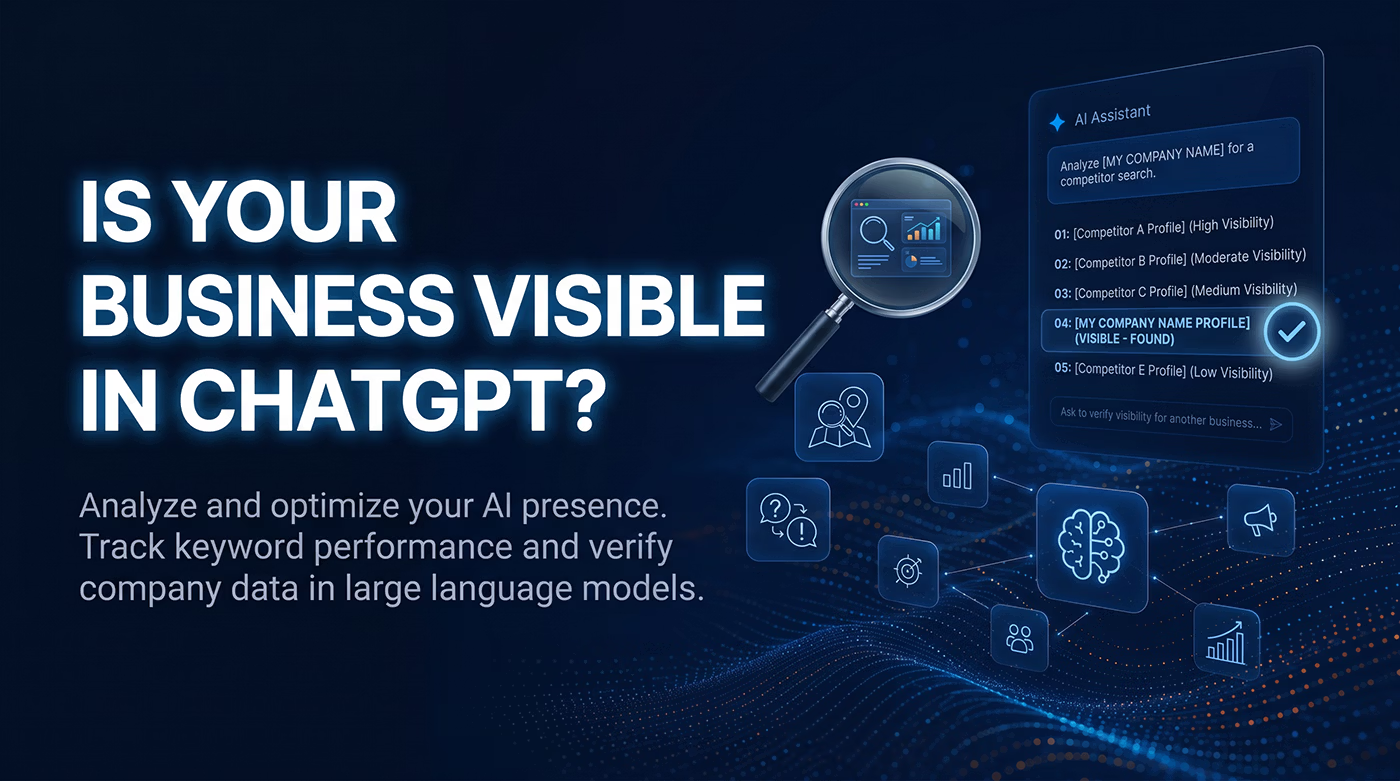
If you want to know whether your business shows up in ChatGPT, don't guess and don't commission a report. Ask the tools the questions a genuine buyer would ask, and read what comes back. The whole test takes about ten minutes.
I run this test with clients before any AI search work begins, because the starting position matters more than the theory. Some firms discover they are cited accurately. Most discover they are absent. A few discover something worse: they appear, but described wrongly, attached to the wrong category or an old version of the business.
This article gives you the exact method: five prompts to run, how to read what comes back, and what absence actually means, because the diagnosis is nearly always different from what firms assume.
The cold-prompt test
A cold prompt is a question asked the way a stranger would ask it. No mention of your business name, no hints, no leading context. It simulates the moment that matters commercially: a prospective client asking an AI assistant for help before they know you exist.
Run each of the five prompts below in ChatGPT, Claude, Gemini and Perplexity. Use fresh chats each time, so no earlier answer contaminates the next. If a tool offers a web-search or browsing mode, run the prompt with it on. That mode is the one closest to how buyers use these tools for recommendations.
Adapt the bracketed parts to your own specialism and region, then run them verbatim:
- "I'm looking for a [your specialism] for my [type of business] in [your county or region]. Who should I consider?"
- "Recommend [category of firm] in the UK that work with [your ideal client type]."
- "I need help with [the core problem you solve]. What kind of firm should I speak to, and can you suggest any?"
- "What is [Your Business Name] and what do they do?"
- "How does [Your Business Name] compare with other [category] firms?"
The first three test whether you surface unprompted, which is the commercial question. The last two test something different but equally important: whether the assistant knows who you are when asked directly, and whether what it knows is accurate.
Record every answer. A simple spreadsheet with one row per prompt per tool is enough. You are about to build the only baseline that matters.
How to read the results
Each answer lands in one of three categories, and each category means something different.
Mentioned, accurately. You appear in the unprompted recommendations, or the direct question returns a correct description of what you do, who you serve and where you are. This is the strong position. Your task is to protect it and extend it, not to relax.
Mentioned, wrongly. The assistant knows your name but has the story wrong: an old positioning, a service you no longer lead with, a location error, or a category you have outgrown. This is common in businesses that have evolved faster than their public footprint. It is arguably worse than absence, because a buyer who receives a wrong description rules you out with confidence.
Absent. The assistant recommends competitors, generalities or directories, and the direct question returns vagueness or an honest admission that it doesn't know the business. For most established firms running this test for the first time, this is the result. It stings, but it is also the most fixable of the three, once you understand why it happens.
One caution on reading the results: these tools are probabilistic, so run the important prompts twice. A single mention in one run is a weak signal. A pattern across tools and repeat runs is a real one.
Why doesn't my business appear in AI search?
Absence almost never means the assistant has judged your work and found it wanting. It means one of three more mechanical things, and knowing which one applies to you decides what you should do about it.
Retrieval versus training data. AI assistants answer from two sources: what they absorbed during training, and what they retrieve from the live web at the moment of the question. Training data has a cutoff and favours widely written-about entities, so most regional B2B firms were never going to be in it. Retrieval is where you can compete. When an assistant searches before answering, it behaves more like a very selective reader than a search engine: it pulls a handful of pages and assembles an answer from them. If your site isn't structured so a machine can extract who you are, what you do and who you serve in seconds, you don't make the cut.
Category association. Assistants recommend from categories, not from directories. If the question is "who does AI strategy for professional services firms in Oxfordshire", the assistant needs to already associate your name with that category. If your public footprint says one thing while your positioning has moved to another, the association doesn't exist, and no amount of technical tidiness creates it. This is the most common diagnosis I see in client work, and it is a positioning problem wearing a technical costume.
Entity clarity. Machines need to resolve your business as a distinct entity: one consistent name, one address treatment, one description that matches across your site, your schema, your LinkedIn presence and the places that mention you. Inconsistency doesn't just weaken you, it fragments you into several half-entities, none strong enough to cite.
What actually moves the needle (and what doesn't)
Once you have a diagnosis, resist the urge to buy a checklist. Most of what is currently sold as "AI SEO" addresses the wrong layer.
What genuinely helps: a site that answers the buyer's questions in plain language near the top of each page, because assistants quote clean, direct statements. Accurate structured data that matches the visible content exactly. Consistent naming and descriptions everywhere you appear. Third-party coverage in the places assistants actually read, because a claim made only on your own site carries less weight than the same claim made about you elsewhere. And a positioning that is specific enough to own a category in the first place, which is where this stops being a technical exercise. This is the core of the practical, business-led approach I take to AI strategy for established firms.
What doesn't move the needle on its own: keyword stuffing dressed up in new vocabulary, hidden text aimed at crawlers, mass-produced AI-written articles, or any tactic that treats the assistant as a system to be gamed rather than a reader to be informed. These tools reward the same things a discerning human buyer rewards, which is inconvenient for shortcuts and good news for firms with genuine substance.
If you want the fuller picture of how AI answers are assembled and the complete on-site and off-site programme, I've written a complete UK guide to AI search optimisation for professional services businesses that goes deeper than this test.
What to do with your results
If you came out mentioned and accurate, document the prompts and re-run them quarterly. AI answers shift as models update and the web changes underneath them, and a strong position unmonitored is a position on loan.
If you came out mentioned but wrong, the work is correction: aligning your site, schema and third-party mentions around the business as it is now, then giving the assistants time and reason to update their picture.
If you came out absent, the work starts with diagnosis rather than tactics: establishing whether the gap is retrieval, category association or entity clarity, because the fixes for each are different and effort spent on the wrong one is effort wasted.
That diagnostic is exactly what the AI Leverage Audit does. I run the cold-prompt testing properly across the major assistants, identify which of the three gaps is holding your firm back, and set out the specific work that changes it, in plain terms and in priority order. If you'd rather talk it through first, my AI Strategy page explains how I approach this work, or you can simply get in touch.
Either way, run the ten-minute test first. It costs nothing, and it replaces a vague worry with a precise starting point.
Frequently asked questions
How do I check if my business shows up in ChatGPT?
Run cold prompts: questions a genuine buyer would ask, without mentioning your business name, in fresh chats across ChatGPT, Claude, Gemini and Perplexity. Test both unprompted recommendations for your category and region, and a direct question about your business by name. Record whether you are mentioned accurately, mentioned wrongly or absent.
Why does my competitor appear in AI answers when I don't?
Usually because the assistant associates their name with the category being asked about and can retrieve clear, consistent information about them quickly. It is rarely a judgement on quality. The common gaps are category association, entity clarity and a website that machines cannot easily extract answers from.
Does being absent from ChatGPT mean my SEO is bad?
Not necessarily. AI search visibility overlaps with traditional SEO but is not the same thing. A site can rank respectably in Google and still be invisible in AI answers if its positioning is unclear or its content isn't structured for extraction. The two need to be assessed separately.
How often should I test my AI search visibility?
Quarterly is a sensible cadence for most established firms. Models update, retrieval sources change and competitors publish, so a position held today is not guaranteed in six months. Keep the same prompts each quarter so results are comparable over time.
What is an AI Leverage Audit?
It is a structured diagnostic I run for established firms as part of my AI strategy work. It tests your visibility across the major AI assistants with proper cold-prompt methodology, identifies whether the gap is retrieval, category association or entity clarity, and sets out the specific work that would change your position, in priority order.